
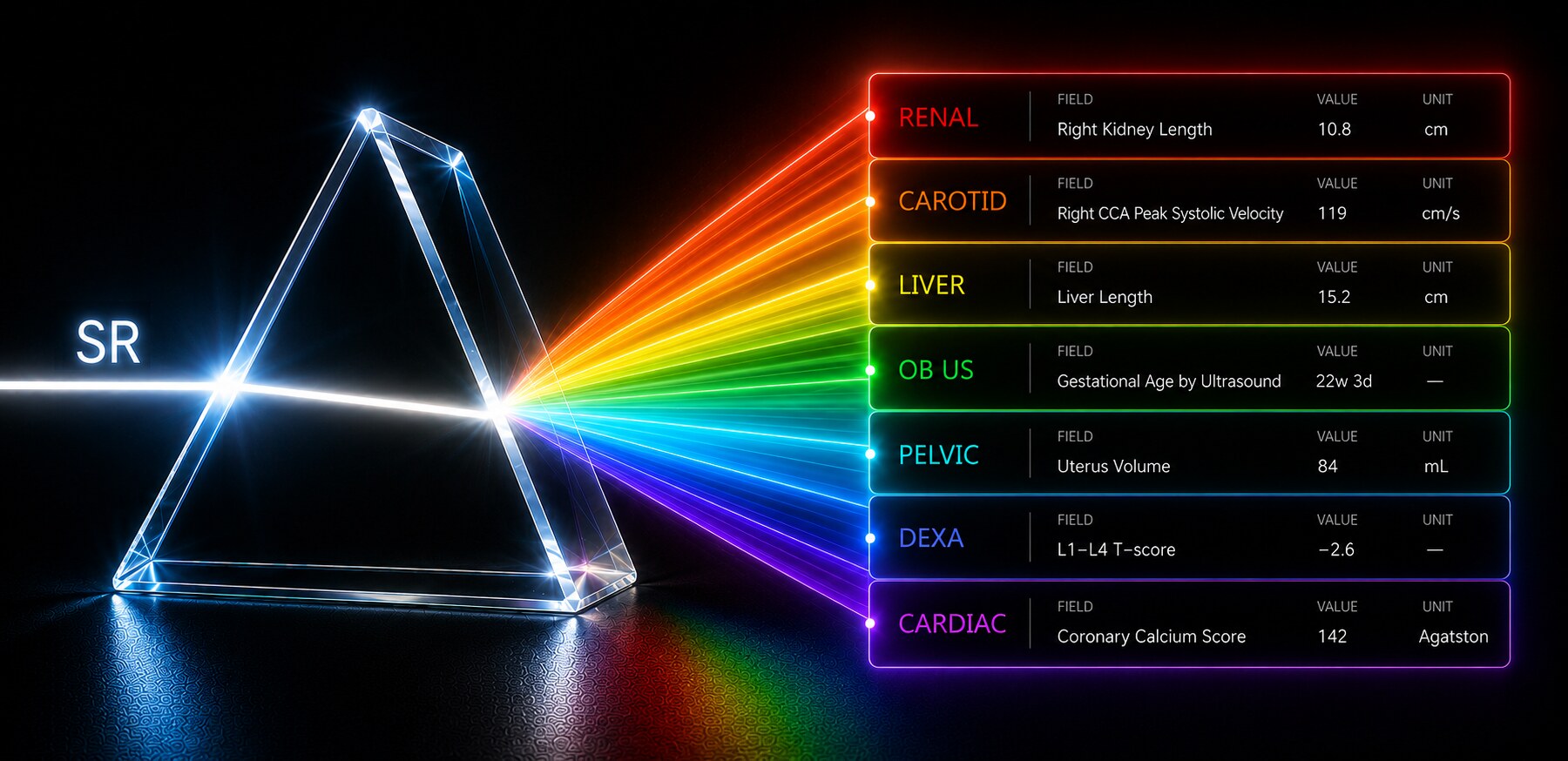
The measurements are already in the study.
They should already be in the report.
Modern imaging systems emit measurements as structured data. Much of it never reaches the radiologist's report, because there is no path from the scanner to the reporting field. PrismLink is that path.
The problem
An ultrasound machine measuring a kidney records the length, width, height and volume as discrete, coded, machine-readable values in a DICOM Structured Report (SR). By the time a radiologist finalizes the report, those numbers have usually been read off a screen and dictated back in — or simply left out.
That re-dictation is slow, and it is where voice recognition errors are introduced. The data was exact when the machine captured it. Everything after that point only degrades it.
What PrismLink does
PrismLink receives structured output from imaging systems, maps each measurement to the correct field on the correct report template, applies the site's own units and formatting, and delivers it into the reporting system as discrete report data — before the radiologist opens the study.
Receive
DICOM Structured Reports and HL7 ORU results, received directly from modalities and information systems on the hospital network.
Map
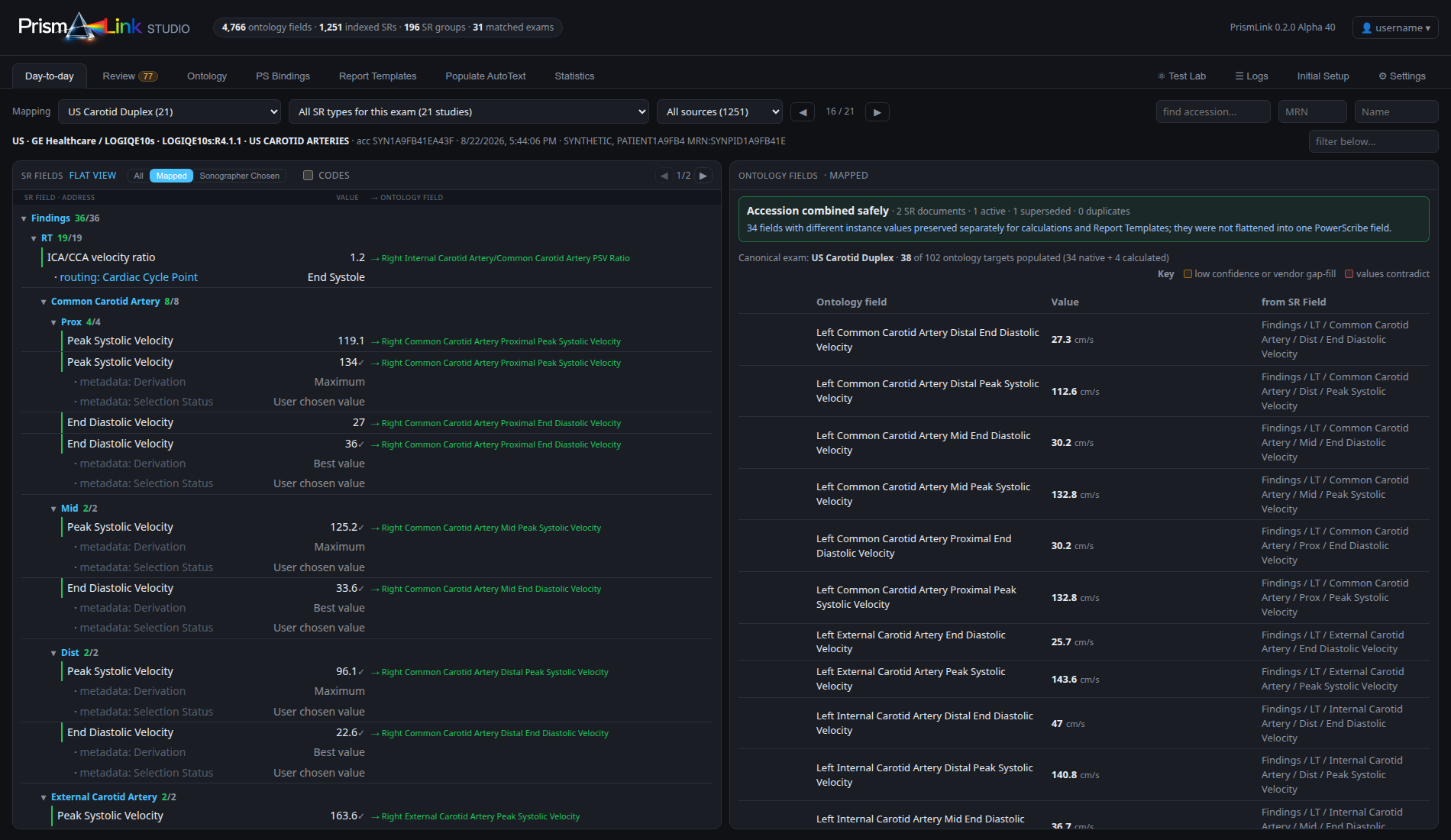
Each vendor encodes the same measurement differently. PrismLink resolves those encodings against a curated clinical field ontology, per exam and per device.
Transform
Unit conversion, rounding and site formatting, plus calculated values such as percentiles from published reference tables.
Deliver
Values arrive in the reporting system as discrete custom fields, populated and ready, with a durable record of what was sent and when.
Built to be checked
Clinical software that quietly produces a wrong number is worse than software that produces none. Several design commitments follow from that.
- No AI model runs in the delivery path. Mapping decisions are made during configuration, reviewed by a person, and then executed deterministically.
- Runtime execution is deterministic. The same study produces the same output every time.
- Results can be replayed and audited. A delivered value can be traced back to the exact source it came from, and the decision that put it there is recorded with the person who made it.
- Ambiguous data leaves the field empty. Where the evidence does not clearly support filling a field, PrismLink declines rather than guessing. An empty box is visible to the radiologist; a plausible wrong value is not.
- Split into isolated services. Receiving, processing and delivering run as separate Windows services, each with access only to what its own job requires.
- Designed for on-premises deployment inside the healthcare organization's own network, alongside the imaging and reporting systems it connects.
For the deployment and data-handling model, see Security. For what PrismLink accepts and produces, see Capabilities.